France 2026
Sacré-Cœur Basilica
Step 1 · Before you enter · ~15 sec

Sacré-Cœur Basilica

Sacré-Cœur is a church that was built as an apology — for losing a war, and for what Parisians did to each other afterwards. The white stone you're looking at is self-cleaning: every time it rains, the basilica gets whiter.

Stand outside · play the audio first, then read on.

Step 2 · The story · ~2 min

Why this place exists

This is not just a church. It's an apology written in stone.

In 1870, France lost a quick, humiliating war to Prussia. The emperor was captured; Paris was besieged through a freezing winter where people ate the zoo animals. Once the Prussians left, Paris turned on itself. The Paris Commune — a radical workers' government — held the city for ten weeks in the spring of 1871 before the French Army marched back in and crushed it. The fighting started on this hill, Montmartre, where the Communards had hidden the National Guard's cannons. By the end of la semaine sanglante — "bloody week" — somewhere between 10,000 and 20,000 Parisians had been killed by other Parisians. Bodies were stacked in the streets.

Out of that trauma, two wealthy Catholic laymen — Alexandre Legentil and Hubert Rohault de Fleury — made a private vow: if France was spared further disaster, they would build a basilica dedicated to the Sacred Heart of Jesus as an act of national atonement. The National Assembly approved it in 1873. The site they chose was deliberate: Montmartre, the hill where the Commune began. Construction started in 1875 and dragged on for forty years — funded almost entirely by private donations from across France, sometimes a single stone bought by a single family. It was consecrated in 1919, just after another war.

The political left has always read this as a victors' monument planted on the Communards' grave. The Church has always answered with the monstrance you saw inside: continuous prayer, every minute, for 141 years. Both readings are true. The basilica is at once a place of mourning, of provocation, and of stubborn devotion — which is why standing on its steps watching Paris go gold at sunset feels heavier than the postcards let on.

Read more about the architecture →
Step 3 · Going in

Here's how

Best time to visit

For us: arrive 19:00–19:30 on Day 1. Sunset in Paris on 22 June 2026 is 21:54, so we have a wide golden-hour window. Two hours covers everything without rushing.

Why this window: it threads the needle between the daytime tour-bus rush (worst 11:00–17:00 in summer) and the chaotic sunset crowd that piles on the steps from ~20:30. Pre-sunset light is still flattering for photos but the steps are manageable.

Entry strategy

  • Funicular, not the stairs. €2.15 per person (or one Métro ticket). Day 1 we're tired from the flight — save the legs for the dome climb if we choose it. Funicular runs from Place Saint-Pierre at the base.
  • The basilica entrance is the main central door at the top of the steps. Free, no queue at this hour.
  • For the dome, the entrance is outside on the left side of the basilica — a separate door marked "Dôme". Pay €8 cash or card at the booth.

Recommended route

  1. Funicular up (skip the climb). 2 min.
  2. The steps — pause for the panorama before going in. The view is east-to-west: in this light you can pick out Notre-Dame's silhouette, the Panthéon dome, the Opéra. Save Eiffel Tower spotting for after — it's to the south-west, harder to see from the front steps.
  3. Inside the basilica — head straight up the central nave to the apse mosaic (see Look #1). It's the largest thing in the building and the easiest to miss if you don't look up.
  4. Right side, midway — find the monstrance above the high altar (see Look #4). Note that there are always people praying in front of it — keep voices low.
  5. Decision point: climb the dome? Yes if we have legs and time (last admission 20:00). No if Roxana or Melek are flagging — the climb is 300 narrow steps with no elevator, and the panorama is similar from the front steps. If yes, 30 min round-trip.
  6. Back to the steps for sunset. Find a spot on the side terraces (less crowded than the central steps). Stay 15–20 min after sundown for the city-lights moment.

Tap ⓘ at the top right anytime for hours, address, prices.

Look at this · 1 of 5

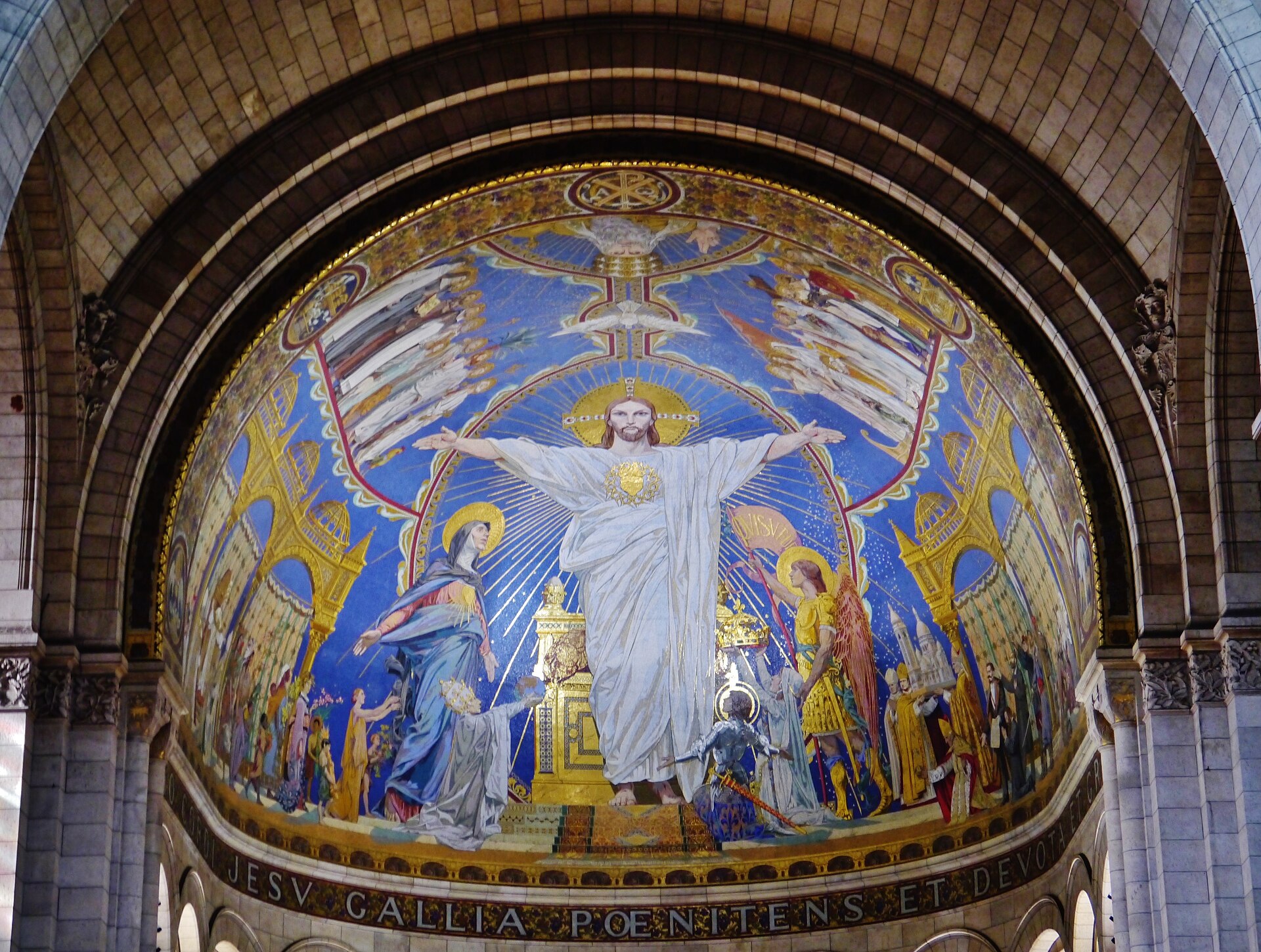
1. The apse mosaic — *Christ in Majesty*

Where to find itAbove and behind the high altar, the half-dome at the far end of the nave. You can't miss it once you look up.

Look forChrist in white, arms open, golden heart on his chest. To his right (your left), kneeling, Joan of Arc with a crown. Above her, the Virgin Mary. Below Christ at his feet, a small figure in red holding a globe — that's Pope Leo XIII, who consecrated the basilica.

Why it matters · 475 m², 25,000 ceramic pieces, completed 1923. Among the largest mosaics in the world — bigger than the apse mosaic in Hagia Sophia.
Look at this · 2 of 5

2. The white stone that whitens with rain

Where to find itAnywhere on the exterior — the steps and façade are made of it. The lower walls are a good place to look closely.

Look forA very fine-grained off-white limestone, almost like sugar. You're looking at Château-Landon travertine, quarried in the Seine-et-Marne region.

Why it matters · This stone secretes calcite when wet. Paris rain dissolves the surface and redeposits it as a fresh white film. The basilica gets whiter with weather — the only major Paris monument that doesn't need cleaning.
Look at this · 3 of 5

3. The Savoyarde — France's largest bell

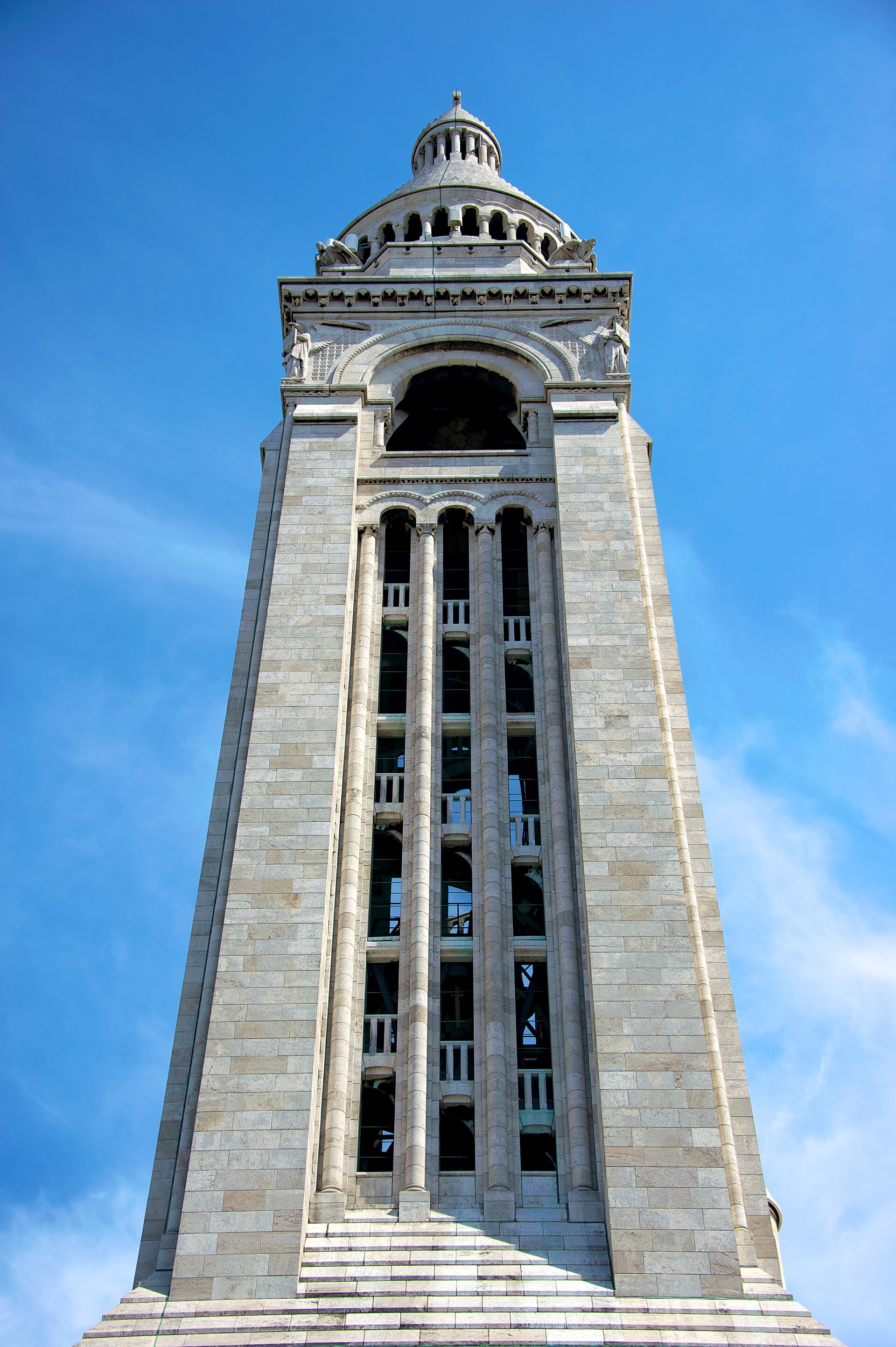
Where to find itInside the campanile (bell tower) — you can't see it directly from the basilica floor, but you can hear it. It chimes the hour.

Look forListen, don't look. The tone is exceptionally deep.

Why it matters · 18,835 kg, 3 m diameter — the largest bell in France. Cast in 1895 in Annecy (Savoy), hauled to Paris by an exhausted team of horses. Named "La Savoyarde" after the region.
Look at this · 4 of 5

4. The monstrance — perpetual adoration since 1885

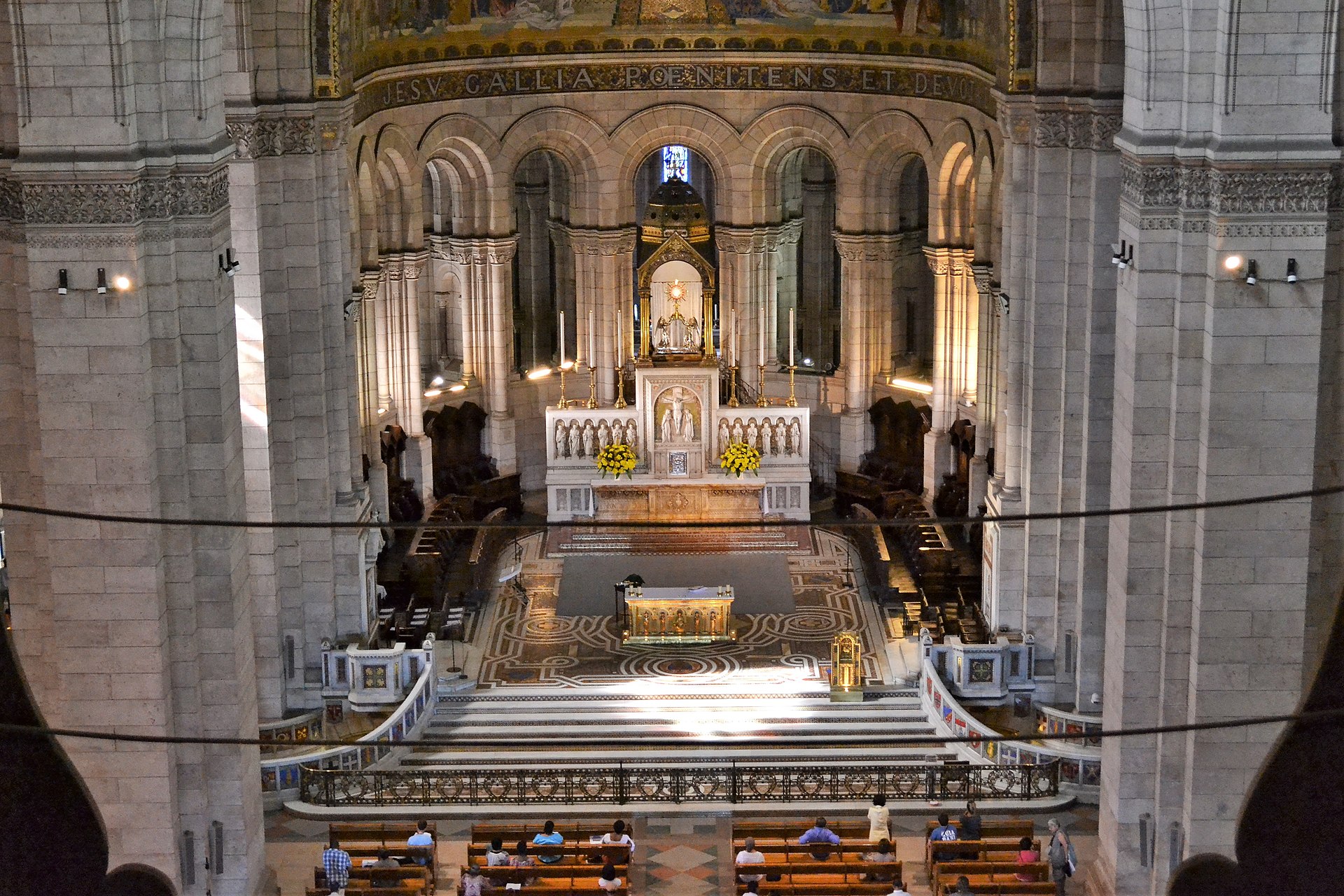
Where to find itAbove the high altar, in line with the apse mosaic. A golden sunburst-shaped frame containing the white Eucharist host.

Look forThe host has been continuously on display in front of someone praying — every minute, every day, since 1 August 1885. Two world wars. The 1944 bombing of Montmartre. COVID lockdowns. Never interrupted.

Why it matters · Almost 141 years of unbroken prayer is unusual even by Catholic standards. There is always at least one volunteer keeping vigil; at 2 a.m. on a Tuesday in February, someone is there.
Look at this · 5 of 5

5. The view east from the front steps

Where to find itStand on the front steps facing south (away from the basilica). Move to the side terraces for a less crowded angle.

Look forThe view is east-to-west. Picking landmarks in order from left (east) to right (west): Panthéon dome (large grey dome, Latin Quarter); Notre-Dame silhouette (after restoration, fully open since 2024); Tour Saint-Jacques (Gothic tower, central); Centre Pompidou (industrial pipes visible at distance, near foreground); Opéra Garnier (greenish dome, right); Tour Eiffel (far right, low — partly blocked by trees).

Why it matters · This is the highest natural point in Paris (130 m at the dome). The view is the reason Communards put their cannons here in 1871, and the reason the basilica was placed on this spot rather than another.
Almost done · before you leave

Did you see these?

Tap any photo you spotted to mark it.
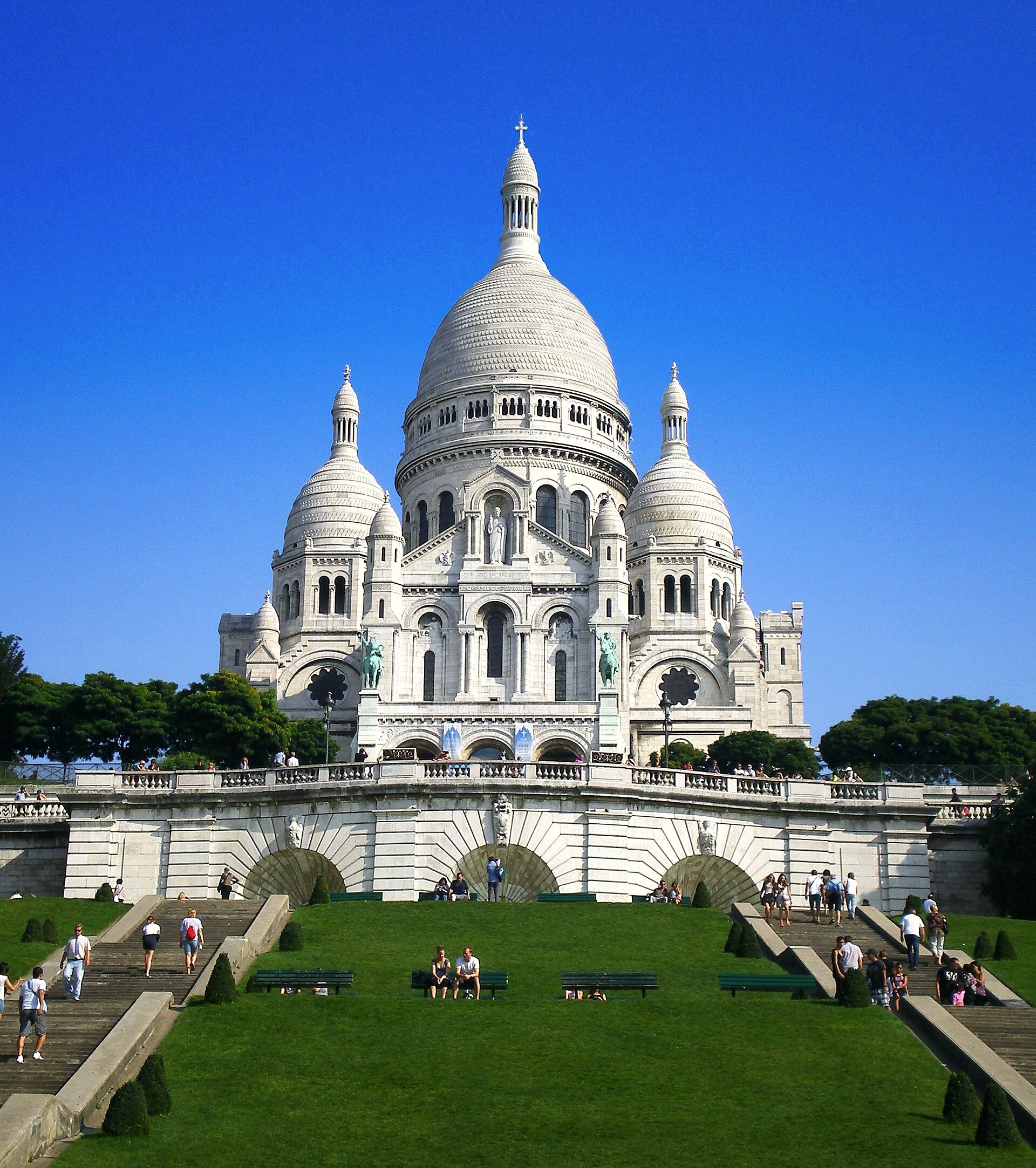
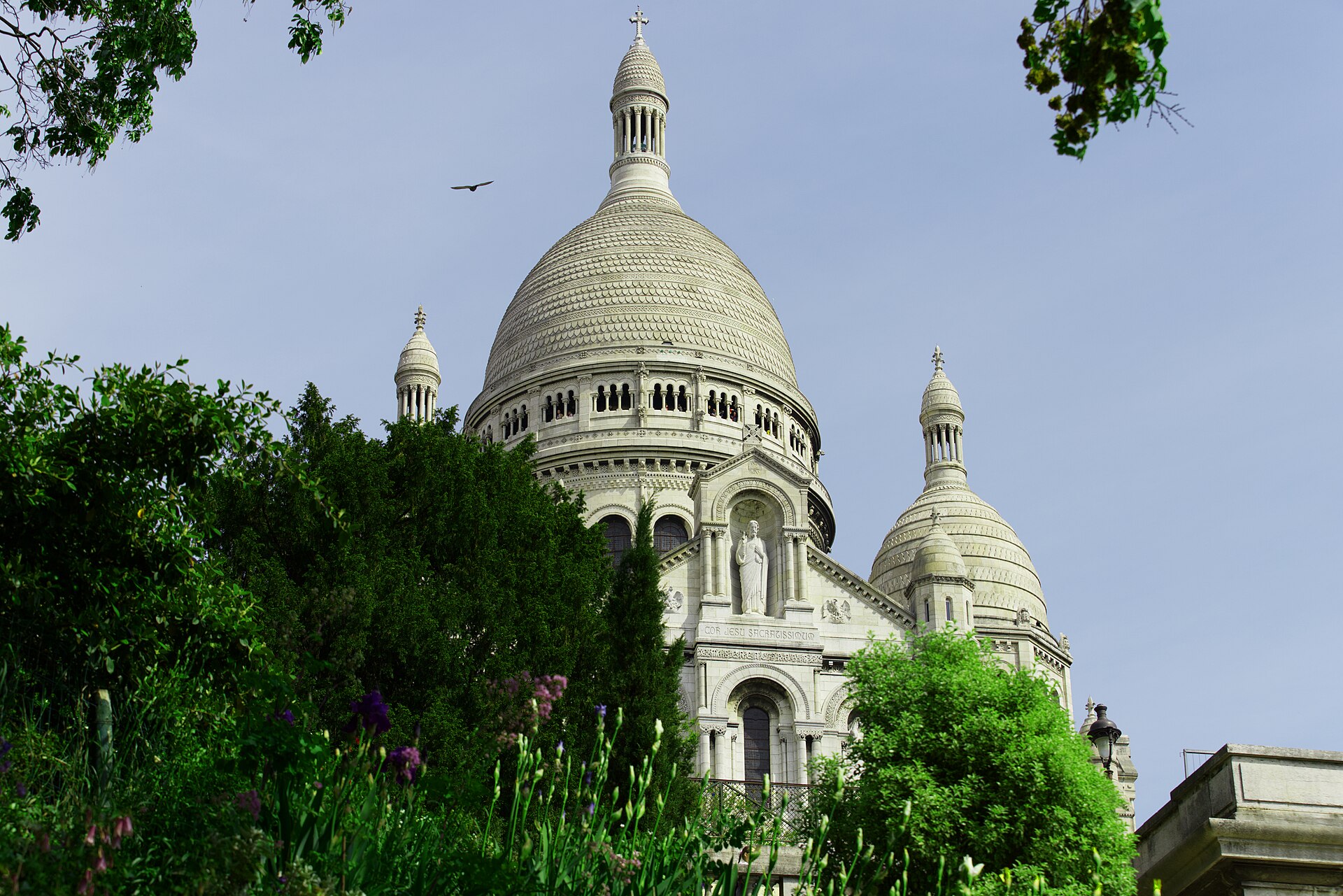
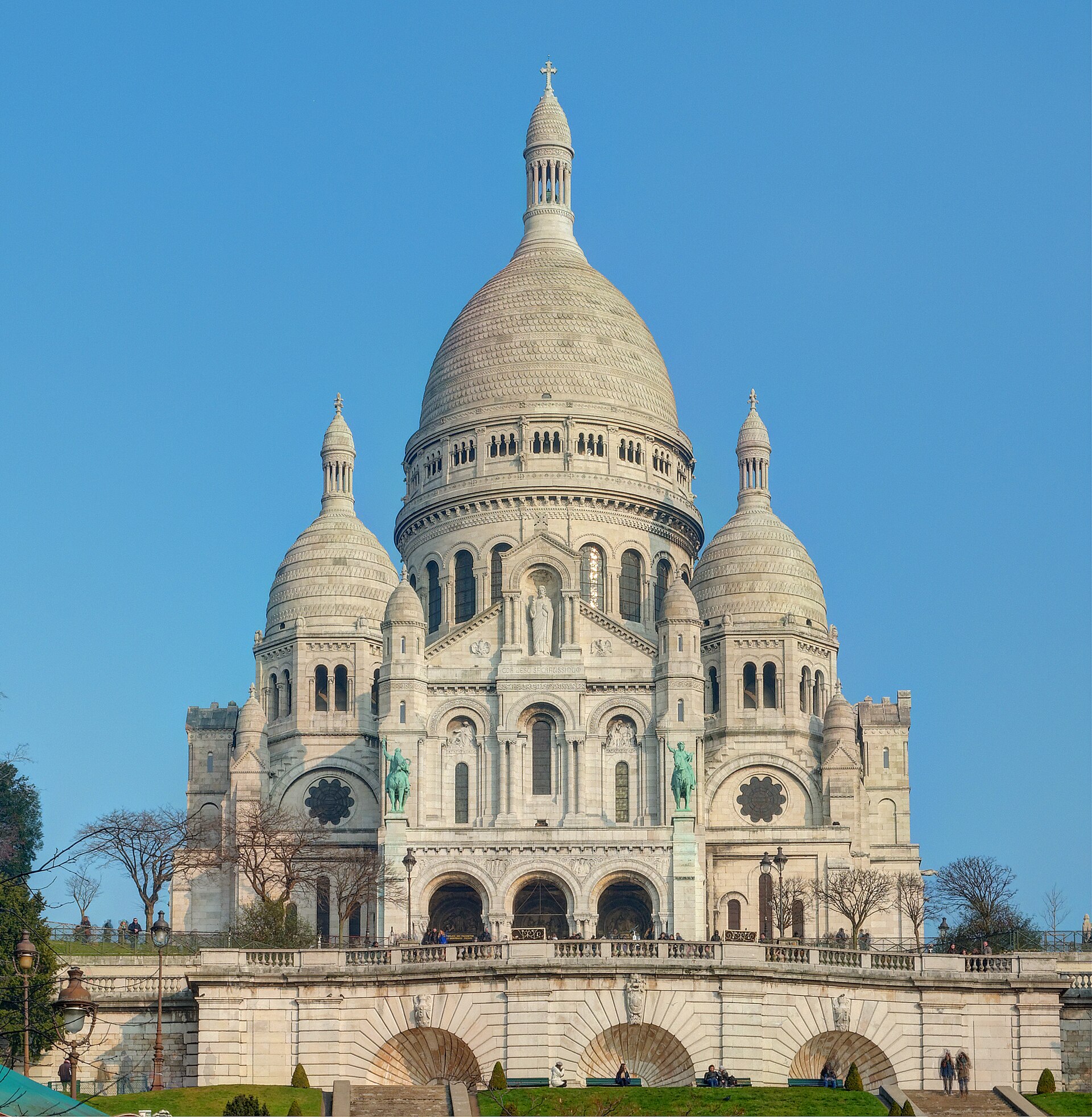
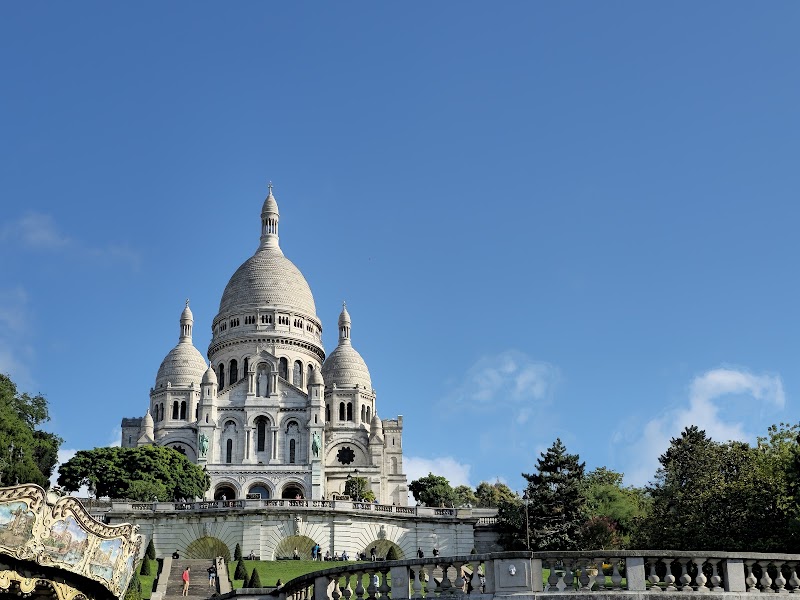
Exterior view from the base of Montmartre — twin small domes flanking the large central dome, all white travertine.
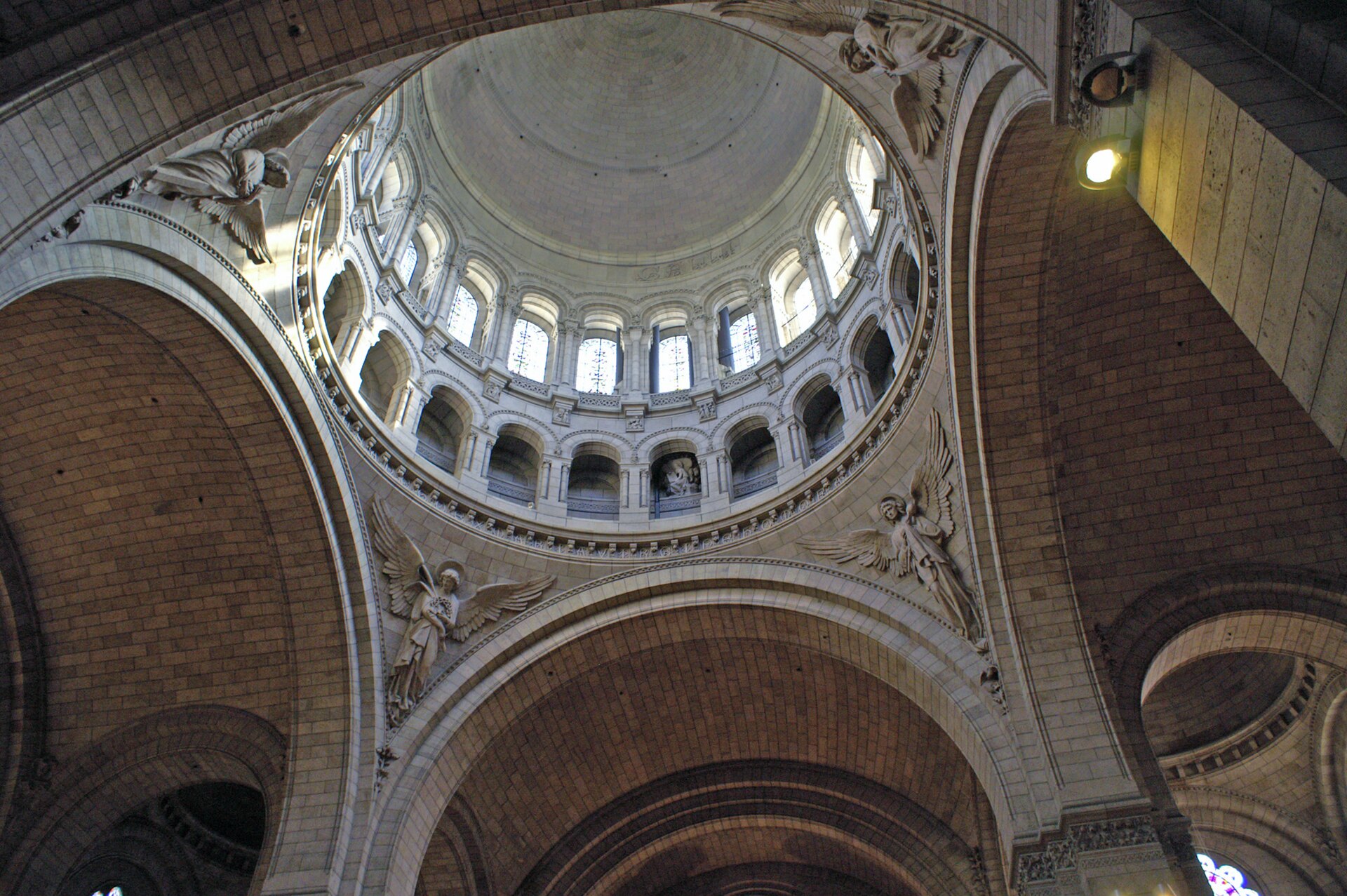
One of the interior side domes — look up when you're standing in the transept; the sculpted angels mark the corners.
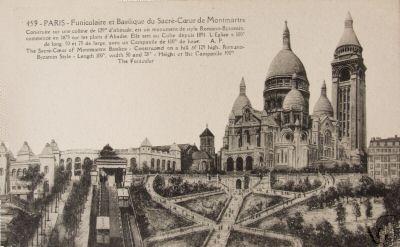
The funicular line (historical photo, c. 1905 — modern cars are bright blue/white). Runs from Place Saint-Pierre to the basilica terrace, one Métro ticket. Take this, not the stairs.
The south facade — main entrance, the door at the top of the steps. This is what you'll be facing when you arrive.
Done · time to eat

Nearby eat & drink

Practical info

Address 35 Rue du Chevalier de la Barre, 75018 Paris
GPS 48.8867, 2.3431
Open Basilica: 06:00–22:30 daily, free entry
Dome Apr–Sep 09:00–20:30 (last admission 20:00), closed midday for break; €8 adult / €5 child; on-site tickets only, no online booking
Avg visit 60–90 min (incl. steps + interior); +30 min if climbing the dome
Booking Walk-up. No reservation possible.
Official site https://www.sacre-coeur-montmartre.com/en/

Architecture & context

The architect was Paul Abadie, who beat 77 competitors in the 1874 design contest. He chose a Romano-Byzantine style — onion-like white domes, round arches, mosaic interior — deliberately not Gothic. Gothic in the 1870s carried strong associations with medieval kingship and the Catholic France of before 1789, and the project's backers wanted to look forward, not backward. The Romano-Byzantine choice gave the basilica a deliberately "Eastern" silhouette unusual for Paris; locals at the time compared it to a wedding cake or a mosque, neither always meant kindly. Abadie died in 1884, ten years into construction, and five architects after him took the project to completion in 1914. It opened formally in 1919 once the First World War ended.

The basilica is not a cathedral and never has been — Notre-Dame remains the seat of the Archbishop of Paris. Sacré-Cœur is officially a minor basilica, a papal designation granted to important pilgrimage churches.

A footnote worth knowing: in 1944, during the Allied liberation of Paris, a stray German shell struck the basilica's apse. No one was killed. Some say the explosion left a small dent visible in the mosaic if you look closely at the lower-left corner of the Christ figure.